OneCasino registration verification: what the account process involves
 Available in US
OneCasino’s account process combines ordinary registration details with identity and address checks that can become more important when money is withdrawn. The useful distinction is between the information entered at signup, the documents that may be requested later, enhanced checks around financial activity, and the controls available once an account is active. Those stages have different purposes, so treating them as one generic “KYC step” can obscure what a player may actually encounter.

Table of Contents
When extra financial checks can appear
OneCasino says a smaller group of customers can be asked for proof of finance, and that withdrawals can trigger enhanced due diligence. That makes the cashout stage particularly important because a withdrawal request can bring account information, identity evidence and financial review into the same process.
Enhanced due diligence is not the same thing as the ordinary registration form. The signup data forms the account identity and contact profile; later checks can ask for supporting evidence where OneCasino considers additional review necessary. The operator’s privacy material places proof of finance in that narrower category rather than as a universal registration field.
For a player, the practical consequence is that a successful login and funded account do not mean every later transaction will proceed without another request for information. A withdrawal can become the point where the operator asks for identity, address or financial evidence to be reviewed together. The separate payments guide explains how that verification layer fits alongside OneCasino’s first-withdrawal funding and wagering conditions.
- Registration data: forms the basic account profile.
- Identity and address evidence: can be used to match the account to a real person and residence.
- Proof of finance: can be requested for a smaller group rather than every account by default.
- Withdrawal review: can trigger enhanced due diligence and therefore make supporting records relevant at cashout.
This sequencing matters when planning a withdrawal. Keeping the account details consistent with the identity and address evidence used later reduces the chance that ordinary differences in names, addresses or contact information become another issue to resolve during the review. OneCasino does not state a fixed timetable for those checks, so the account process is better understood by the kinds of evidence involved rather than by assuming a standard number of hours or days.
What registration asks for
OneCasino lists a fairly conventional set of registration data: username, password, date of birth, address or place of residence, gender, name, email and phone. Together, those fields form both the login credentials and the personal profile attached to the account.
The fields can be grouped into three practical categories. Username and password are access credentials. Name, date of birth, gender and residence details describe the person associated with the account. Email and phone provide contact information. Thinking about the form this way helps explain why later identity checks can compare documents with information already stored on the account.
| Registration field | Role in the account record |
|---|---|
| Username | Account identifier used with the login process. |
| Password | Credential protecting access to the account. |
| Name | Personal identity information that can later be compared with documents. |
| Date of birth | Personal profile information relevant to age and identity checks. |
| Address or place of residence | Residence information that can later be compared with proof-of-address material. |
| Gender | One of the personal-data fields listed for registration. |
| Contact detail tied to the account. | |
| Phone | Contact detail tied to the account. |
Because the account can later be checked against ID and address evidence, accuracy at signup has a practical value beyond simply completing the form. If a name or address changes, the important point is that the account record and supporting evidence should describe the same person rather than creating avoidable mismatches.
Identity and address checks
OneCasino says verification may require an ID card or passport and proof of address. Those documents answer two separate questions: who the account holder is and where that person resides. They also connect directly back to the name, date of birth and residence fields collected during registration.
An identity document is therefore not a substitute for the whole account profile, and proof of address serves a different role from a passport or ID card. A complete review may need more than one type of record because one document can show identity while another supports residence information.
- Account record: the registration fields create the personal profile.
- Identity evidence: an ID card or passport can support the name and identity attached to the account.
- Address evidence: proof of address can support the residence information stored in the profile.
- Additional review: proof of finance can enter the process for a smaller group, especially where enhanced checks apply.
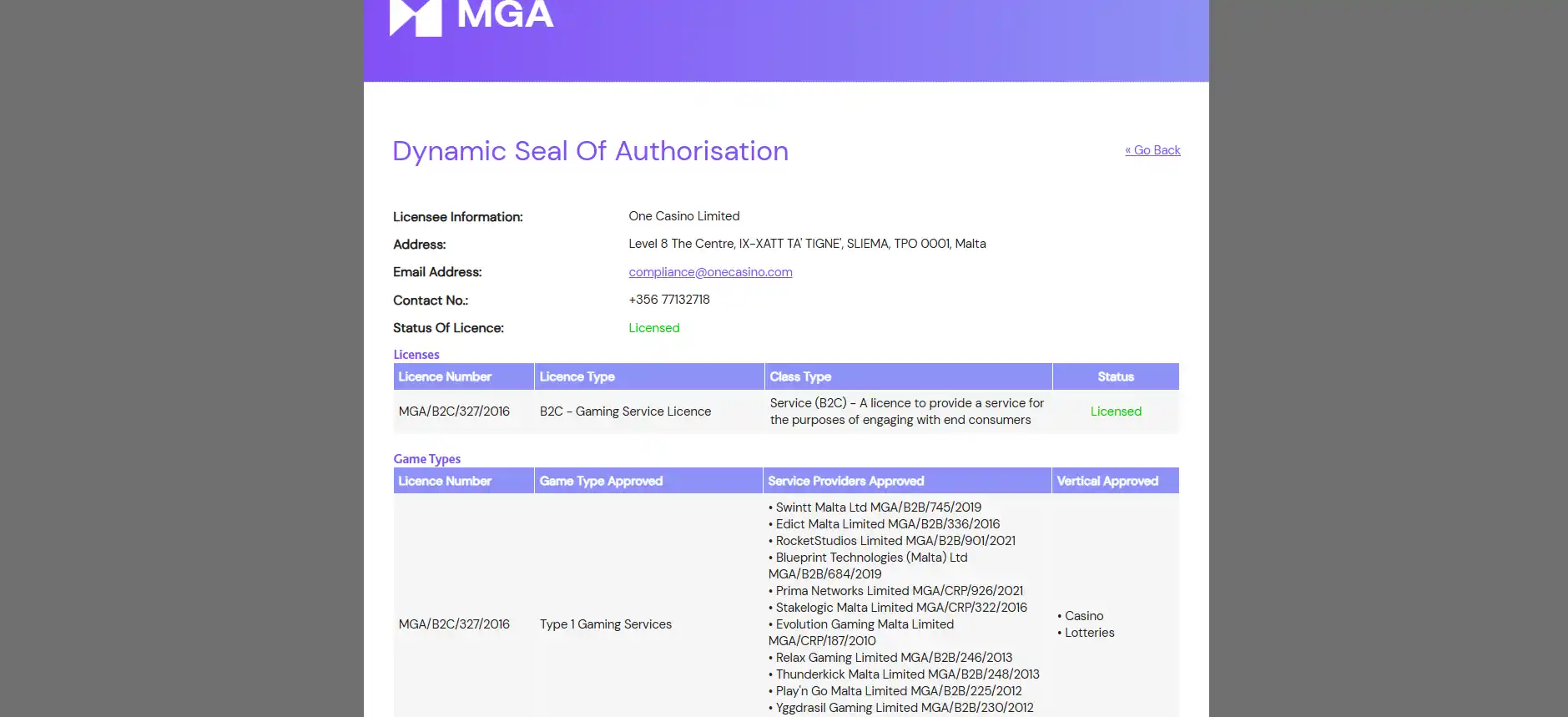
The important planning point is that these are account-level checks rather than game or bonus conditions. They affect whether the operator can be satisfied with the account holder’s identity and supporting information. For the separate question of how the operator is authorised and what that means in the Canadian country-level profile, the license and safety guide keeps that regulatory material in its proper place.
Account closure and fraud clauses
OneCasino’s terms say that accounts closed for fraud, including cases involving a false identity or duplicate accounts, can have the balance removed or voided. That makes identity consistency more than an administrative detail: the operator connects false identity and duplicate-account conduct to consequences for the account balance.
The clause is most useful when read together with the registration and verification process. The operator asks for identifying information at signup, can request ID and address evidence later, and reserves stronger consequences where it treats the account as fraudulent. Those pieces describe a system in which the account record is expected to correspond to one real account holder.
Duplicate-account risk is also distinct from ordinary verification friction. A request for documents does not by itself mean an account is being treated as fraudulent. OneCasino states that fraud examples such as false identity or duplicate accounts can lead to closure and balance removal or voiding. It does not support turning every document request into an accusation or every delay into a closure risk.
A cautious account practice is therefore straightforward: use accurate personal details, keep one consistent identity profile, and respond to account checks with records that match that profile. That does not guarantee a particular outcome, but it keeps the account behaviour aligned with the information structure described in OneCasino’s terms and privacy material.
Limits, time-outs and self-exclusion
OneCasino lists several player-control tools: deposit or spending limits, wager or loss limits, session controls, time-out or self-exclusion, reality checks and account closure. These controls address different parts of gambling behaviour, from how much money enters or is lost to how long a session continues.
The operator also applies a seven-day cooling-off period to increases or revocation of limits. That delay is important because it prevents an immediate change from making a protective setting less restrictive in the same moment that a player wants to continue spending or gambling more.
| Control | What it is designed to manage |
|---|---|
| Deposit or spending limits | The amount of money allowed into or through gambling activity. |
| Wager or loss limits | The scale of staking or losses over the relevant limit period. |
| Session controls | The duration or structure of a gambling session. |
| Reality checks | Prompts intended to interrupt continuous play with a reminder of time or activity. |
| Time-out or self-exclusion | A break from access, ranging from a temporary pause to stronger exclusion. |
| Account closure | A direct route to ending the account relationship. |
These tools are most useful when chosen before a session rather than after a loss has already created pressure to continue. A deposit or loss limit can define the financial boundary, while session controls and reality checks address time and pace. Time-out, self-exclusion and account closure are stronger options where continued access is itself the problem.
19+ in Canada. Gambling can cause financial harm. Keep spending within limits and stop when it stops being entertainment. Support is available at gamblingtherapy.org.
Questions about OneCasino registration and verification
What information does OneCasino ask for at registration?
OneCasino lists username, password, date of birth, address or place of residence, gender, name, email and phone among the registration data it collects.
What documents can OneCasino request for verification?
OneCasino says verification can include an ID card or passport and proof of address. It also says proof of finance can be requested for a smaller group of customers.
Can withdrawals trigger extra checks?
Yes. OneCasino says withdrawals can trigger enhanced due diligence, so identity, address or financial checks may become relevant during a cashout review.
What player controls does OneCasino provide?
OneCasino lists deposit or spending limits, wager or loss limits, session controls, time-out and self-exclusion, reality checks and account closure. Increases or revocation of limits are subject to a seven-day cooling-off period.
The account is easiest to manage when identity and controls are set early
OneCasino’s account process is clearest when its pieces are separated. Registration creates the identity and contact record; ID or passport and proof of address can support later verification; proof of finance can enter enhanced checks for a smaller group; and withdrawals can be the point where those checks become more intensive. Alongside that, the operator offers financial and session controls with a seven-day delay on loosening limits. The practical value is not in treating verification as a one-time hurdle, but in keeping the account information consistent and using protective controls before gambling behaviour becomes harder to manage.
Read next
Prepared by the Play-onecasino.org editorial staff.